Saturday, September 29, 2018

SOLD: A Rare Surviving Oil on Canvas by Colonial African-American Artist Joshua Johnson


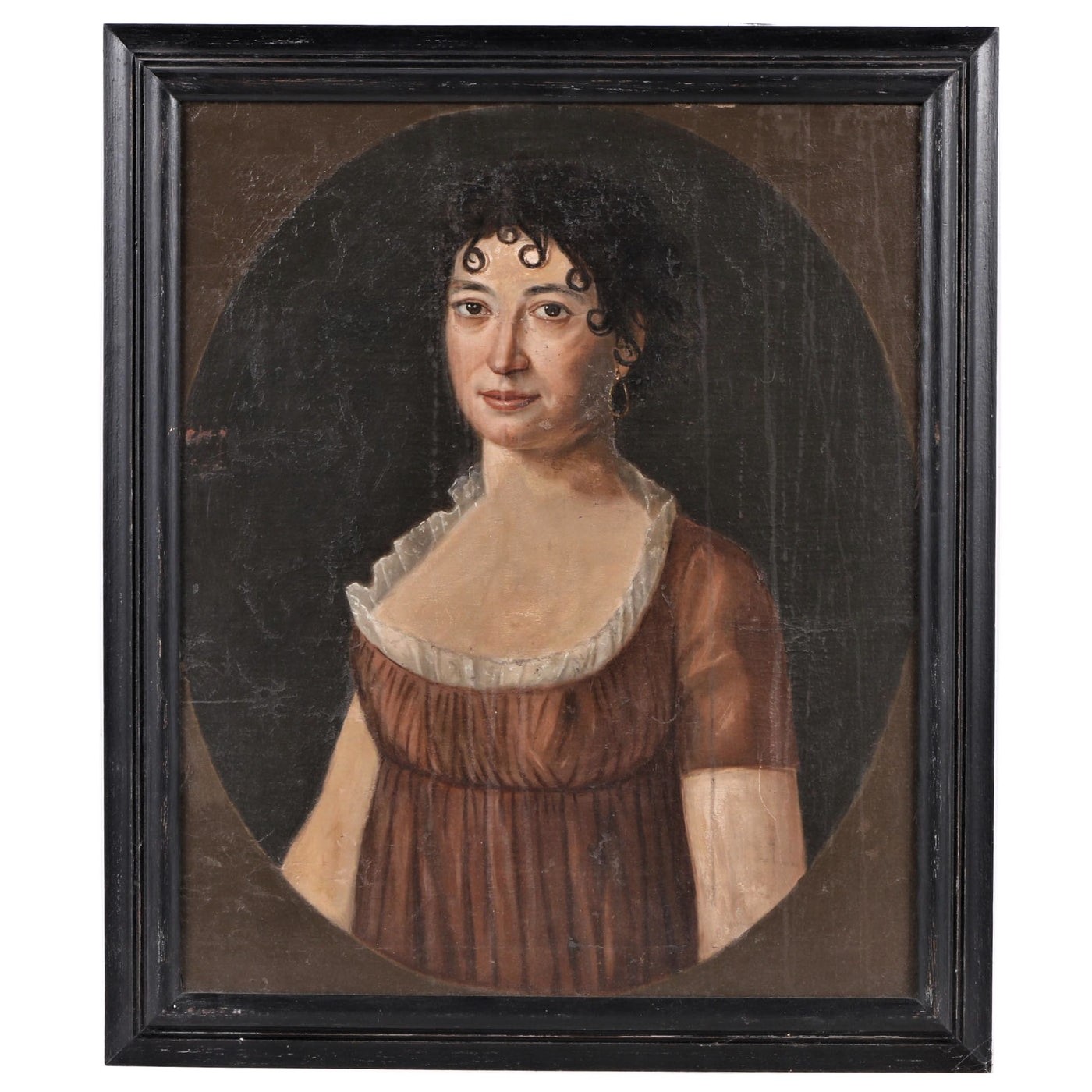
Offered is an important ca. 1800-1805 portrait of a lady by America’s first African-American portraitist.  It purportedly depicts Mary Crozier, born in Maryland ca. 1781, a part of the greater historic Catholic migration to Nelson County, Kentucky.  Thought to have been painted from a pre-existing miniature, this rendition was accomplished in Baltimore by the famed Joshua Johnson and descended in this prominent Maryland- Kentucky- New Orleans family, having recently surfaced in the latter city with descendants of the sitter and dispersed in Kentucky.  Mistakenly attributed initially to the Spanish Colonial portraitist Salazar who worked in a similar style, consultation with several Louisiana art scholars determined this was in error.  Gaining more family provenance, I found the portrait came from the early Maryland Crozier family via Bardstown and was taken to Mississippi by descendants, passing through grandson Edward W. Crozier Jr. of Washington County, MS (see The Papers of Jefferson Davis 1846-1848).  Further published reference to the family can be found in Randall Capps' book on Federal Hill and the Rowan family, who knew them very well, in addition to the biography of Mother Catherine Spalding, Mary being one of her closest friends outside the convent.


As a caveat, I need to explain that Johnson portraits are extremely important artistically, historically, & culturally.  Johnson, born enslaved, was America's first important black colonial artist.  He works are scarce, with little recent auction record (most have spurious attributions).  The oil on canvas of Mrs. Crozier, a classic example of Johnson's figural interpretation, warrants restoration, however, it displays well "as is" and would be suitable to many collectors without any work done.  It has, though, endured 200 years of the climate of Kentucky, Mississippi, and Louisiana as well as two early 20th century restorations that weren't of the quality we might demand today.
This portrait has certainly suffered from its long Southern ownership.  A hot, moist climate is a painting’s worst enemy!  There are no tears or punctures that I can note, but the canvas has undergone at least 2 early 20th century restorations.  It was removed from its original stretchers and laid onto board.  There are scattered losses, mostly to the background, but some noticeable small losses to the extremities of the face and arms are found that were restored with an amateurish hand.  Subsequent minor areas of loss were as well poorly colored in without adding filler first.  The worst, most obvious facial losses are found on at the left cheek/neck, the left chin, and at the right shoulder/chest, all having been crudely in-painted in the old restorations.  More in-painting and over-painting can be seen in the dress and background.  Overall, she survives in fair but displayable condition, and while the piece warrants restoration, it can, again, easily be hung “as-is”.


I at first thought the frame to be a replacement, which it may well be, but it appears to be Southern yellow pine, and of a decent age itself.  I'd need to examine it further, but it's a decent frame and may well be period
Still, despite condition issues, she is a Southern folk beauty, another surviving Johnson masterpiece, and remains basically intact and ready to hang.  Due to the undeniable condition issues, however, she will be priced accordingly, far less than the record range for Joshua Johnson's portraits.  At this time, I can find but a single Johnson portrait on the market, offered by a New York art dealer and priced “to the trade” at $180,000.00.  Considering the scarcity and importance of the artist, this range may well be justified.    I can, on request, provide that dealer’s data sheet which explains better than I the importance of any surviving canvas by Johnson.  It, like the Crozier portrait, is unsigned, as all Joshua Johnson portraits are, but was oddly not presented in "ovolo" as is more common for Johnson to have done.  The Crozier portrait displays Johnson's signature ovolo framing of the subject, as well as the common palette of colors expected.  It’s a quintessential example of the American Master’s work.


This link takes you to a discussion of the restoration of Winterthur's Johnson portrait.   Very enlightening.
http://collectingforthefuture.winterthur.org/portfolio/joshua-johnson/

Tuesday, August 21, 2018

SORGHUM IN THE SOUTH; Part IV


presented by Gary Dean Gardner, Independent Scholar


The following is a transcription of a fascinating period article on sorghum as it appeared in the official Report by the Kentucky State Agricultural Society for 1857.  Not commonly available to scholars, I am offering it “as written” as a contemporary statement to accompany my own previous work on this history of early sorghum experimentation here in the Commonwealth, for it offers an intriguing insight into the introduction of this now common staple and the overall agrarian and food culture of the lower & upper south of the middle 19th century.  Interestingly, the author is a Mercer County, Kentucky woman, Maria Burton Thompson Daviess (erroneously initialed Mrs. M. J. rather than Mrs. M. T. Daviess).  Here she relates to a rather scientific audience her accounts concerning the rare finds of an antebellum Southern woman in conducting agricultural experimentation where generally such a realm was reserved specifically for the male landed gentry of that day.  As you read, do keep in mind that Maria, when speaking of men, women, and children working in the sorghum-making process, is referring not to her family or neighbors, but rather to enslaved labor.  We must recall that she reflects the culture and morals of her time, in a region where the economy was based upon slavery and the profits derived from it.  Most fascinating is her clear relationship with both the women and men at the Shaker community of Pleasant Hill, and the unusual acceptance by the male farm managers in working with Maria.  It should be remembered that the Shakers were ahead of their time in establishing the equality of women in work, politics, and overall society.  And, while perhaps irritating to some modern readers, I have left Mrs. Daviess’ spelling, and extensive comma use, as written.  My only editing consisted of the inclusion of a few missing hyphens and the clarification of a single misspelled word.

Maria Daviess won a $20 prize in the form of a coin silver pitcher for her essay on "Chinese Molasses" in the 1857 "South Western Agricultural and Mechanical Association" fair. Her prize, now unaccounted for, was a duplicate of this example by Louisville, Kentucky silversmith John Kitts which was awarded the prior year to essayist Arthur Peter for his 1856 winning entry on "Fruit & Fruit Trees of Kentucky."


Maria's exploits in crop diversity during the 1850s had remained virtually unknown to most historians and scholars until now.  She is best remembered for her classic History of Mercer and Boyle Counties, originally published as a series of articles, but printed as a book by the Harrodsburg Herald in 1924.  Maria Burton Thompson, daughter of John Burton and Anne Porter Robards Thompson, was born in Harrodsburg 31st October 1814.  She married Major William Newton Daviess on 24th October 1839, and died in Mercer County 21st December 1896.
Thank you Jerry Sampson for your assistance in preparing this!


Daviess Home in Harrodsburg, KY


A Familiar Essay on the Cultivation, Uses, Etc., of Chinese Sugar Cane, by Mrs. M. J. Daviess, of Harrodsburg, Kentucky, October 5th, 1857.

The result of a few days labor in syrup making from this plant, has satisfied the writer that when the concurrent testimony from experimenters from various sections of the country shall be made known, the success of the season will be so astonishing, that information will be sought, or on no other agricultural subject with the same eagerness and earnestness.  This plant, like other of the rarest luxuries we possess, and the higher blessings of our spiritual nature, is another blessing from the oriental world.  It is to France0 ever the pioneer of science and civilization- we owe the introduction of this plant to the wester world; or, rather, a revival of the knowledge of its existence; for there seems to have been a series of attempts, from the fifteenth to the seventeenth century, to produce sugar from it made in the Italian provinces.  In examining an elaborate history of China lately, I find Millet mentioned as one of the productions of the country, but no mention made of its peculiar qualities.  M. Matigny, and Agent of the Geographical Society of France, found it in use in the northern part of China, one of the doubtless many valuable things locked up by the jealous policy of the Celestials from their ever intrusive and, as they consider, barbarous western neighbors.

To the beneficence of our own general government we are indebted for this plant in the United States.  For some years past Congress has made a commendable appropriation for the purchase of foreign seeds and plants for general distribution and experiment.  The value of this one plant, entitled to rank at once as a staple, and destined to work an important change in the commercial relations of the country, will amply reimburse the outlay of this department and vindicate the policy of the government, even to the most economical and censorious of the vigilant guardians of its Treasury.  Mr. Brown, the Agent of the Agricultural Department found this plant in France and sent it over, in his collections, to the patent office.  It is evidently of the same botanic family to which our common Broom and Dourah Corn belong, hybridizes with them readily, and has their botanical names Holens Saccharatus, Sorgum Saccharatum, etc., etc., variously assigned to it.  Lately several new kinds have been introduced from Africa, under the name of Imphee, which, with the species previously known, makes some thirty varieties.  But, from careful comparison of different statements, and from the similarity of plants raised from seeds produced in different sections of our own country, I am satisfied there is no essential difference in quality, save that produced by climate- Chinese Sugar Cane, like all saccharine plants, increasing in richness as it nears its tropical nativity.  It acclimates itself, however, readily to any latitude where Indian corn will grow, dwarfing in size as plants from warm climates to in colder latitudes.  It was first distributed in 1854, and it as, considering its value and the weight of foreign testimony in its favor, gained ground very slowly.  But the morus multicaulis mania, the hen fever, and Chines potato humbug, have so debilitated public faith, that, instead of receiving and trying with wise caution the novelties each season offers, the masses are disposed to reject and ridicule every thing not know to their fathers before them.  Thus, the south has suffered, year after year, the disastrous effects of drouth and frost, while the ready resource of Chinese sugar was at their doors; prices of all saccharine products have risen to a value that amounts almost to a prohibition of their use to the poor, and yet sugar cane, instead of having a fair trial in our fields, continues to be, in many minds, quite as suggestive of humbug as syrup.

In running over the reports to the Patent Office and newspaper clippings, I find that, from St. Paul, Minnesota, to the neighborhood of New Orleans, the plant has been grown, and, in some cases at northern points, has ripened its seed.  The latter point is not, however, essential to the manufacture of the syrup, but the strong presumption is, that where the summer not long enough to ripen the seed, the saccharine qualities are not rich enough to be valuable as a sugar crop.  In several of the states intermediate between these points, persons have experimented, and in all cases have report favorably to its growth.

CULTIVATION.

In France and her Algerian possessions, the plant, like all other field crops, has been chiefly cultivated with spade and hoe, and treated with manures, irrigation, etc.  There, as here, it suckers freely, and is deprived of the offset, and it is recommended, when seed is not an object, to cut off the panieles so soon as they appear.  Our northern and eastern farmers make mention, as usual, in their agricultural reports, of the manures used- bone dust, guano, etc., etc.  Such application might prove valuable even here, but I presume none will be found necessary beyond the usual rotation of crops practiced.  Neither France nor own eastern brethren mention an average of stalks so tall or large in diameter as has been generally produced in this section on ordinary ground, without any especial favor.  It is presumable that, in any corn growing region, ground prepared as for that staple, and the seen planted in hills or drills wide enough apart to permit the use of the plow, will be found a satisfactory mode of cultivation.  The seen should be planted as early as possible, to avoid the frost, (the plants being tender in their first stage,) but the earlier, with safety, the better, as it gives a longer chance to work up the crop after maturity.  If planted in hills, two stalks should be left to the hill; in drills, the plants should be left eighteen inches apart.  The plants, when they first appear, are scarcely distinguishable from grass, and require careful attention to prevent the overgrowth of weeds before the plow can be used.  After that the cultivation of cane differs no way from corn, and its thrift will soon show what care has been given it.  In later stages of growth, a casual observer would hardly notice the difference between the field of can and corn, but the stalks are slender, the joints longer, the leaves narrow and more flexuous, the seen heads resembling Dourah corn, but erect, and when ripe, jet black.  The stalks are covered with a white substance, which has a frosty appearance and which chemical analysis has proved to be wax.

The piece of ground cultivated on our homestead was a hill side, sloping westward.   The seeds planted were procured from several sections of the country, but chiefly from the Patent Office.  The ground was well prepared and sowed in drills, June 8th.  The plants were very much neglected when they first came up, but had afterwards the best tilth by plow and hoe.  They were carefully suckered, though at seems, from conflicting statements, a doubtful practice, (certainly not advisable if raised for forage).  On some plants overlooked, the suckers grew as tall as the stock plant and bore see, but stock and sucker were inferior in size and height to the plants where were deprived of the offset.  Some of the plants have measured eighteen feet in height and one and a half inches in diameter; the average height of the canes is about fifteen feet, and one inch in diameter.  Not one-half of the seeds have ripened at this date.  The panicles weight about one half pound and would fill a half pint.  The cane is apparently hardier than the corn, presenting a vivid contrast to the corn fields, the leaves of the cane, though scorched, retaining a strong, green color, while the corn is perfectly seared and dry.  The cane, however, has become very brittle and is dying rapidly, without any perceivable dimunition [sic] (diminution) in the quantity of juice, or change in the flavor, from the tow frosts that have fallen.

USES AND VALUE.

Notwithstanding the recent revival of the use of this plant in Europe, and its introduction into our country, it has been already ascertained to be capable of manufacture into several articles, and of course possesses a variety of values.  Giving, in our references, the precedence to France, as she deserves, for her prompt and laborious investigation on this subject, I find she givers in her testimony in favor of the Chinese Sugar Cane, as a plant of immense use for a foraging crop, and as of surpassing value as a syrup producing plant.  Likewise, that is will probably be of vast service in shielding the bread crops from the distiller’s grasp, as it yields a larger percentage of alcohol than any cereal used hitherto.  Recently they have succeeded n making sugar, but not so successfully as some of our home experimenters.  It has been used as a fermented liquor, and considered as agreeable as cider, and may also be used for vinegar.  Brandy, in combination with the grape stems, has been manufactured from it of superior quality.  The seeds have been converted into chocolate, and their husks into dye for silks; and one experimenter ahs succeeded in procuring from it such large quantities of wax, that he thinks that product, alone, would justify its cultivation.  In the United States, unless in this season, its value has not been tested, except as a forage crop and syrup producing plant.  Its value for forage has been highly extolled in all sections of our country, especially in those regions, where the severity of the winter makes that species of food indispensable.  It is said to contain ten per cent more of nutritive matter than Indian corn, and has produced from five to nine tons of feed to the acre.  Indeed, the Algerians consider the plant as perennial, and in South Europe, and in the same latitude of the United States, it produces two or three vigorous growths the same season.  It is though, by early planting in the sugar growing districts of the Union, two crops might be produced in a season, for syrup-making.  I observe that where a few stocks were cut for experiment, in August they are shooting up luxuriantly, which affords fair ground for conclusion, that the aftermath, even in this State, after manufacturing the first crop, would prove a good resource for stock from our dry fall pastures.  Poultry eat the seed with great avidity, and the seed heads would be managed easily for cow food, as they would require no preparation, before boiling, in the way of cutting or grinding.  The hardness of the stock would seem to render cooking necessary to the use of this plant for stock food, in order to render it easily digestible.  But, the chief value to the United States of the Chinese Sugar Cane, is its qualities as a sugar plant.  At the North it will not be in this use valuable; to the South, it will stand, if the seed are kept on hands, as an unfailing resource, when frost has cut off the common cane.  To the corn and cotton growing regions it supplies a desideratum a want severely felt in late years, while all sweets have ruled so high.  Families of competent means, of course, have not been curtailed of their luxuries, by high prices, but our laborers have felt the privation severely; and considerate master, even if not moved by the higher motive of promoting human happiness, will find it, in a sanitary and economical view, it is best to add a little field of Sorgo to their other annual crops, for home consumption.  The thrift of negroes, in sugar season, has passed into a proverb in the South, and of late years the vapors from the sugarhouse have begun to emulate Hunter’s inhalents [sic] as a remedy for consumption.  The use of molasses, as an inducement for the less free use of animal food, has been a part of the economy of many well regulated western farms for years.  It is well known, the use of pork is considered by intelligent medical mean, as the cause of the very common prevalence of scrofula and cachexia, in that class of our population.

EXPERIMENTS

Since the introduction of this plant, in 1854, into this country, in various parts, it has been tested with different contrivances of power, from the rolling pin and pastry board up to the best quality of small iron mills.  The results from the use of the last class of machinery has been known, up to this fall, chiefly from Dr. Peters, of Georgia, who has done the country incalculable service, in pioneering the way of his countrymen into a new field of agricultural wealth.  In every experiment, by every power, however contemptible, the result has been successful, and as enormous as seemed Dr. Peters’ calculation, (from five to six hundred gallons per acre) the last few days has proved to my mind satisfactorily that his figures are not exaggerated, and I doubt not many, ere this, in the South, could add their testimony to his.  As the press is teeming every day with new publications on this subject, *unfortunately too many the growth only of bookmakers’ brains,) the writer deems it unnecessary to lengthen this essay by a list of names and methods.  She has briefly run over whatever in the history and habits of this plant she has gleaned from newspapers and Patent office reports, that others less sanguine than herself have not thought worth remembering, but since the fruits of this season warrant the belief of its wonderful usefulness and adaptedness to our climate, would now be interested to know, without the labor of collecting.  I will, therefore, proceed to give the familiar details of our experiment in Sorgo Sucre, (the manufacturing part having been under my personal supervision,) because I believe that the experiment of one in the same climate, in the same condition of things, with only the ordinary household conveniences, will afford greater inducements to one to embark in the enterprise, than the most elaborate directions of the most scientific chemist in the country.

Rock fences dividing the pastures at Shakertown of Pleasant Hill near Harrodsburg, KY


Another reason for venturing this familiar paper before so grave and respectable a body, is that circumstances have favored her with as exact knowledge as personal observation, of the method practiced by the Friends, or Pleasant Hill, Mercer county, Kentucky, could give.  The known character of this Society as farmers, and the established reputation of the Sisters in all housekeeping matters, will be a warrant to all, of the goodness of the method adopted, after bringing the science of an excellent chemist and the skill of constant experience to bear on it.  It is well known the Sisters of this Industrial Society spend their summers in manufacturing tons of preserves, jellies, etc., as celebrated as the cattle, which are the pride and care of the brethren.  The above reasons have satisfied me to submit this essay, hastily written, amid the cares of a large family. To which, at present, is added the supervision of a new branch of industry; and the motive of public good which has prompted it, I trust, will excuse all marks of literary inability; provided, after testing the products accompanying this, the Society deem proper to send it out, with their endorsement, to the people of Kentucky.  And now, before I proceed to the details of my experiment, I must answer one question which will arise in many minds- How comes this agricultural experiment to go out to the world in the name of a woman, the wife of a living, practical farmer?  I answer, I am one of the daughters of Eve, whose lord elect allows full privilege to follow her fancy; that having had the cane  cultivated for my gratification, when he found it promising, he ordered an inexpensive mill for the experiment, and when the success of the Shakers proved it valuable, made things as convenient as possible for my use; and then, having no experience in kettles or clarifiers, vacated the temporary sugar house, leaving me a dominion wide enough to satisfy any woman’s ambition, seeing it is all out of doors.


The mill, which had been ordered, came to us the middle of August.  It was made by a neighboring cooper, who had seen corn stalk mills in the primitive days of our Commonwealth; price $20.  But this cost would be lessened half by any workman having implements suitable for the job.  The mill is composed of two cylinders, about two feet long and something less in diameter, placed firmly in a stout wooden frame; the upper part of one enters into a sweep, which curves downward; the cylinders have each a set of cogs around the top; the one attached to the sweep turns the other, and the canes are pressed between them.  One horse turns the mill, and having a lead pole attached, no driver is needed.  About six stalks, one above the other, are passed through the mill at a time; the stalks being stripped of leaves and the seed cut off, one person feeds the mill and another receives the bagasse,- as the pressed stalks are termed,- lays them in straight order, and returns them to the feeder.  They are twisted, two or three together, and passed at once through the mill a second time.  Having pressed about two dozen stalks, to test our mill before receiving it, we found ourselves possessed of a bucket of green, disgusting juice.  After straining, clarifying and reducing it, by boiling, we found it had made about one quart of fair looking, disagreeably flavored molasses.  A few days after, one of the managers of Pleasant Hill called to arrange with us for the use of our mill.  We cheerfully agreed to let them precede us in the trial, and having been invited to pass a day with them, seeing the syrup manufacture in every stage of process, we were delighted and elated to find their success complete, and thought no delicacy of the kind had ever proved more tempting than their syrup spread over their delicious butter and unrivalled bread.  The mill was returned to us in improved condition, and a day or two after, Mr. Bryant called with a bottle of syrup, fair flavored, and about the consistency of honey.  I likewise obliged us with written directions, which I have followed, verbatim, in making the article accompanying this paper, which is as follows:

Into four galls of juice, fresh from the press, stir, while cold, one pint of sweet milk, two whites of eggs, beaten, two spoonsful of lime, mixed with water to the consistency of cream.  Set it over a brisk fire, and do not disturb it until it boils.  Then take it off the fire quickly, and after it ahs stood twenty minutes, skim it and put it into tubs.  After twenty-four hours, strain it into kettles, and to each four gallons allow one egg, and one spoonful of lime, to finish purifying.  Boil down to the consistency you like, skimming clear, but is considered finished when the syrup hangs from the ladle, in flakes.

A primitive form sorghum cane press


September 29th, 1857, we commenced operations, and this, October 4th, I note the following items:  That having the cane previously stripped, that a boy and two-horse wagon can draw in what cane the mill will grind, in about four hours.  Distance of field from the mill about one eighth of a mile.  That a stout active man is best to feed the mill, as the yield of juice, after the first pressure, depends on the bagasse being well twisted.  A child of ten years can cut of the heads as fast as required for the mill.  A child of the same capacity can receive, straighten and return the bagasse to the feeder.  One woman, with the occasional help of another, to strain, has run our four kettles, of about eighteen gallons each.  The wood being beside them, and the kettles in a good home-built furnace.  Every stalk passed through the mill yields about one pint of juice, the second pressure equal in quantity to the first and superior in quality.  That six gallons of juice makes one gallon of plantation molasses, and rather less of golden syrup; that molasses may be made in about eight hours direct from the press, but a fine syrup cannot be furnished in less than two days; that the yield of juice is greater from green stalks than ripe, but the produce of molasses about equal.  Fine syrup can only be produced from ripe cane.  That the clearness of the syrup depends upon its being allowed time to settle fully, rather than on a specific clarifier used.  That with the fixtures and force we have mentioned, working steadily for about ten hours, we turned off about ten gallons of syrup each day.  We would prefer shallow kettles, and think the superior fairness of the Shaker syrup was owing to its speedier evaporation, and that in copper kettles.  The above data will furnish items for calculations for home enterprise.  Our acre of Sorgo will yield us two hundred gallons of syrup, half of which could have been engaged to day, had it been for market, at the price of golden syrup.

Whether it shall become one of our staple crops, is a problem for intelligent farmers to work out, but nothing but culpable indifference to the wants of his laborers, and want of energy will prevent any farmer from having the product of Sorgo as abundant in his family as the fruits of his orchard and dairy.

By planting as early as the first of May, the Sorgo season will come on just at the close of harvest, and the leisure weeks between that and seeding time cannot possibly be more profitably spent.  With her fat herds and teeming fields, happy homes, embosomed in fruitful orchards and flowery gardens, Kentucky needed but sugar-cane to make her what her children have ever loved to boast her- the Garden of the World.  MTD

Friday, August 17, 2018

Kentucky's Unknown Story of Jewish Silver

Assessment Of A Kentucky Coin Silver Soup Ladle Ca. 1858-1860

 by Solomon Ralph Biesenthal (working 1858-?)

 Louisville, KY

From the private collection of the much esteemed patrons and purveyors of Virginia and early Southern material culture, S & B B of VA.

 by Gary Dean Gardner, Independent Scholar ©gdg 2018 


Little modern scholarship is available to aid us today in better understanding the dichotomy of life and the integral role of Jewish craftsmen in the slave-based economy of the antebellum American South.  But for coastal cities like Charleston & Savannah, where now ancient Hebrew Temples were established at early periods and allowed 18th century congregants to better blend into these old Southern societies of a mostly welcoming Protestant Christian make-up, the majority of Jewish immigrants in the South came in much later 19th century waves of migration to places like Louisville, Atlanta, & Nashville.  In these commercial centers of the upper and middle South they clustered in neighborhoods segregated by faiths, culture, and a brevity of citizenship, denying many a chance to be fully accepted socially, and thus limiting their footprint upon local history.

 Presented here for examination is a handsome and substantial soup ladle by the scantily documented Louisville silversmith S. R. Biesenthal, who with his wife Rosalie Samuelson and young daughter Julia arrived in America from Poland via Germany & New York in or shortly prior to 1850, settling briefly in Cincinnati where a son Raphael was born.  Biesenthal was advertising his shop on Market Street in Louisville, Kentucky by early 1858 according to the local newspapers.  Though fraternal records of the A. O. U. W. (Ancient Order of United Workmen) indicate Biesenthal resided for a time in Newport, KY during the 1870s, he is mostly associated with Louisville where he worked and maintained a shop until nearly the turn of the next century.  He would die in that city 16th June 1903, with burial in the Temple Cemetery of Louisville.


 Despite mid-19th century discrimination against Jews and even Catholics by the prevailing Protestant population, Biesenthal apparently was proud of his chosen home, generally incorporating a LOUISVILLE city mark beneath the silver punch bearing his name.  Life, though, must not have been easy in Louisville.  The Louisville Evening Bulletin for Saturday the 13th of February 1858 reported a hint of the distrust and animosity he and other Jewish merchants surely dealt with on a daily basis from the public at large.  The paper explained that,


  “A man named S. R. Biesenthal, who keeps a jewelry shop on Market street, was arrested yesterday on a charge of felony. It appears that about two weeks ago a Miss Bacon lost a gold locket and chain. A few days ago she called at Biesenthal's establishment and saw her lost articles. He claims to have had the chain a long time and denied that they were Miss B. 's.  She took out a felony warrant against him and he was arrested.”  


 Trying desperately to prove his innocence, on the 19th Solomon posted in the newspaper the following plea:


 “A LADY WHO, about three months ago, traded with me an Accordion for a Gold Chain, would put me under the greatest obligation if she would be kind enough to call at the store No. 590 Market street, between First and Brook.” 


Despite such obstacles, Biesenthal took a positive, passive approach to life, and concentrated his efforts upon establishing and bolstering a growing Jewish community in Louisville.  Two years after the humiliation of false accusation and arrest, Solomon became a founding incorporator of the “Louisville Hebrew Mutual Benefit Society”, later acting in the same leadership capacity in 1865 to establish & incorporate the “Louisville Hebrew Mutual Aid Society (Cheb rah Bikur Cholim Ukedosho)”.

  Sadly, despite his apparent esteem in Jewish social circles of the city, Biesenthal continued to deal with misfortune.  The Memphis Daily Appeal for 29 November 1869 reported the devastating financial loss incurred by, 

  “Solomon R. Biesenthal's Jewelry store, on Market street, near First, was robbed at four o'clock this morning of gold and silver watches, diamond rings and pins to the amount of $6,000 to $8,000. There is no clue to the robbers.”

   Shadows would continue to fall upon the venerable Solomon Ralph Biesenthal.  Slightly over a year after the theft at his store, Biesenthal’s name made the papers across the South once again with the tragic suicide of his father-in-law.  The Daily State Journal ,
 Alexandria, Virginia, Saturday, 4 February 1871 reads, 


SUICIDE IN A CEMETERY


Abraham Samuelson, a well known citizen of Louisville, Kentucky, committed suicide in the Jewish Cemetery at that place on Tuesday last, by shooting himself through the breast with a pistol. He wrote a farewell letter to his wife, full of expressions of affection, and entreated her not to grieve at the act he contemplated committing. Another letter, addressed to "S. R. Biesenthal," was written in Hebrew characters, with the exception of the following closing lines:

"God bless you and my dear wife and children. Don't have me buried in my clothes. Don't take me to my house. I don't want my Carry to see me." Nothing more. 


This family nightmare, surely humiliating to Biesenthal and his family, made the papers as well in Nashville, Memphis, Columbia, SC, and other cities. 


As for the ownership of this particular ladle and its interesting presentation inscription, again,
too many times little history can be gleaned from public records when the modern scholar is seeking data upon a small, sheltered, and often transient Jewish community.  In this case, the engraving would indicate Biesenthal was actually working in Louisville a few years prior to the documented advertisements for him, for Jetta “Gerslet”, per Jefferson County, Kentucky marriage records, was wed to Solomon Schoenfeld in 1854.  The style of the ladle certainly correlates with the middle 19th century, and the engraved sentiment clearly is a loving affection to remind a new bride of her former identity.  Thus far there is no indication the young couple remained in Louisville, possibly removing to New York where a Jetty Schoenfeld died in 1902 in Brooklyn. 

Grave of Solomon Ralph Biesenthal
In most every instance, Solomon gave his year of birth as 1824, in contrast to the later date used on his tomb stone.


For Reference, see:

 United States Census, Jefferson Co. KY 1850-1900, Hamilton Co. OH 1850 

Boultinghouse, Mark, Kentucky Silversmiths, Jewelers, Clock & Watch Makers of Kentucky 1785-1900

Monday, April 16, 2018

Henry Read; the Valiant, the Conquered, the Forgotten


A Brief Examination of the Life & Times of LaRue County's Greatest Soldier and Rejected Statesman
by Gary Dean Gardner, Independent Scholar
 Of an unknown, unverified source, this image is thought to be one of Read taken in Louisville upon his return from Richmond.

Unlike most American men of the 1st half of the 19th century, Henry Read was a man of many varying professions.  Craftsman, lawman, lawyer, soldier, statesman, he was most of all a servant to his community. 

Henry English Read was born in what today is LaRue County on Christmas day 1824 to Lewis and Ailsey Brown Read, Lewis (b. 5 Jan 1787 Fairfax Co. VA) being a son of Hensley 1755-1825 and Charlotte Kirk Read and Ailsey M. (b. 28 Dec 1793) the daughter of James & Isabella Brown.  Typical for the upper South, they were prosperous “yeoman” planters and slave holders, being amongst the first inhabitants of the Tonnieville section which had been settled by the families removing from the early Goodin’s Station along the Rolling Fork River.  Lewis and Ailsey Read were early members of Hodgenville Methodist Episcopal (South) Church, in whose congregation they raised their children.  Lewis was as well a Whig party political leader in the southern section of what was then Hardin County.  He became active with other prominent men in proposing and advocating for the separation from Hardin to create a new county.   He was appointed one of the first justices for the new county, and later became its Sheriff. 

The Reads were married in 1813 and had a large family consisting of Belinda, James, William Brown, Nathaniel, Julia Ann, Nannie, Henry English, Charles, Caroline, Lewis, John Mary Jane, and Joshua Joseph.  Of these, William displayed the earliest aptitude at public service and early on became a successful lawyer.  The subject of this sketch, however, initially shunned such a vocation and instead was apprenticed to become a blacksmith.  The war with Mexico changed Henry’s path forever.  Like many young Kentucky men swayed by patriotic fervor inspired by the newspapers of the day, Henry Read enlisted in President Polk’s newly created elite Voltigeurs after recruiting was commenced 4 March 1847 and joined the one company formed in Kentucky, serving under Colonel Thomas Patrick Andrews of Washington, D. C.

Serving in the campaign with distinction, Henry displayed his natural capacity for leadership on the battlefield where he was dangerously wounded several times yet heroically pressed on until his body could sustain no more.  Afterwards Read, wounded and basically abandoned by the Armies, made his precarious and dangerous journey home to Hodgenville alone, arriving as one of our greatest military heroes in any generation before or since.  He would be recognized by the Kentucky Legislature for his heroism some years later.
Resolution #4 would be approved 18th February 1854.  It read, “Whereas, Henry E. Read, of LaRue County, late ensign in the regiment of Voltigeurs, under the command of Col. T. P. (Thomas Patrick) Andrews, during the war with Mexico, performed gallant services for his country, having been engaged in every battle that was fought in the valley of Mexico- in all of which he conducted himself as a soldier and a Kentuckian, bearing aloft the flag of his country, until he fell covered with wounds under the walls of Chapultepec.  There, Resolved by the General Assembly of the Commonwealth of Kentucky, That the governor of this state be authorized to procure and present to Henry E. Read, in the name of the Commonwealth of Kentucky, a sword, as a token of the admiration and gratitude of this general assembly for his gallantry and patriotism manifested in said war.”  Preserved and protected within the Read family by his son John Wesley, this treasured relic was given to the Filson Club where it remains today. (Acts of the General Assembly of the Commonwealth of Kentucky: Vol. 1, 1854 p. 188)

from The Courier-Journal 13 February 1938

Home again, war veteran Henry Read would forever be slightly disabled, preventing him from taking up the hammer to the anvil again as a primary vocation.  He instead followed his father’s lead at last.  The 1850 Federal Census gives us a glimpse of a rather influential household in the newly formed LaRue County, a proud success for the elder Lewis Read.  Family #3 was headed by elder sibling William Brown Read, 32 years of age, and already a respected attorney, his wife Sarah, and borders William H. Waide, 37-year-old merchant, and H. M. Rowlett, a rather prosperous lawyer.  The final resident of the home was William’s younger brother, and Mexican War hero and now Sheriff of LaRue County, Henry English, then 25.  He had in fact succeeded his own father, Lewis, in that position.  Henry’s term as County Sheriff was apparently peaceful.  He submitted the tax returns for the county through 1852.  (Reports Submitted to Both Branches of the Legislature of Kentucky for the years 1849-1852) 

Henry’s developing political ambitions were successfully rewarded just a few years later in his bid for statewide office when he was elected to the Kentucky House of Representatives by LaRue County in 1853, serving in that capacity through 1855.  While State Representative in 1854, Henry married Charlotte C. Doran in LaRue County on the 30th of May 1854.  She was the daughter of Hart County planter Thomas Doran and his wife Mary who, in 1850, were listed in the Census Slave Schedules as the owners of 16 men, women & children.  The young couple became parents to sons John Wesley Read (1857) and William Doran Read (2 Feb 1855), as well as Mary and Thomas who died as infants. (Collins Historical Sketches of Kentucky:  History of Kentucky Vol. 2. P. 457; Daily Commonwealth, Frankfort, KY multiple issues 1853-55, Legislative Directory)

Years after the conflict with Mexico we find reference to Read’s first humble profession, the one forsaken for politics and the law.  The Congressional Globe (VOL 35; First Session of the Thirty-Fifth Congress, p. 2138) for 14th May 1858 explains the introduction of “A bill (H.R. No. 257) to increase the pension of Henry E Read, a citizen of Kentucky, and for other purposes.  The bill raises the half pension heretofore allowed to Henry E. Read, of Kentucky, a non-commissioned officer in the Mexican War, to thirteen dollars a month.  The second section enacts that the benefits accruing to Henry E. Read, under and by virtue of this act, shall commence 3 March 1848, and continue for and during his natural life.  It appears from the report that Sergeant Read entered the army intended for the invasion of Mexico, in Louisville, Kentucky, in the spring of 1847; that he was in every battle fought by the American arms from Vera Cruz to the city of Mexico; and until he fell desperately wounded in the abdomen, in the right shoulder and right arm, at the storming of Chapultepec; that his conduct in every engagement was that of a truly courageous citizen soldier, until his fall at the storming of Chapultepec, with the colors of his regiment in his hands, on the 13th of September, 1847.  The committee further report that Sergeant Read’s profession or calling before he entered the Army, was that of a blacksmith; and that he has been compelled, by the wounds received in the defense of his country, to abandon his trade; and that he is wholly unable to perform manual labor, and is in that condition at this time.  The committee further report that Sergeant Read was honorably discharged from the service in the city of Mexico, while in the hospital, where he lingered for seven months, and had ultimately to find his way home as best he could.  The bill was laid aside to be reported to the House with a recommendation that it do pass.  Page 2165 reports the ultimate passage of this bill for the relief of Henry English Read.  Ironically, when the Senate was presented with this Bill, Alabama Senator Clement Clay, with whom Read would one day be a political colleague in the Confederate government, objected to it.  Hearing the Bill read, however, followed by the personal testimony of Senator John Burton Thompson of Harrodsburg, Kentucky who knew Read and “how he was shot…all to pieces”, Clay soon gave in and the Bill was as well reported to the Senate and passed. (The Congressional Globe, p. 2695)

That decade of the 1850s was leading our nation to strife no one could have fathomed, but the national discourse on states’ rights and regional division as well sharpened Henry’s appetite for politics.  His older brother William, assuming a strong Unionist attitude, was serving in the Kentucky Senate and being mentioned in the right social circles as a leader of greater aspirations, serving as Delegate to the infamous Democratic National Convention of 1860 in which Stephen Douglas was chosen to face the Read Brother’s former neighbor, Abraham Lincoln, in the race for President that eventually erupted in Civil War.  The succession of events after Lincoln’s election is perhaps as boggling today as it must have been then.  With the arrival of spring in 1861, “secession” was the buzz word, and War had been declared between American states but Henry Read, like many Kentuckians, held on to hopes of neutrality and a quick end to any hostilities.  Despite the turmoil that both gripped and electrified the nation, Read succumbed to even greater political aspirations than could be found in the mostly Union-controlled Kentucky House, running unsuccessfully on the “Southern Rights” ticket for Fifth District seat in the United States Congress.  (Louisville Daily Courier 19th June 1861) Still considering himself an American and supporter of the Union, he ran against, and was soundly defeated by, former Kentucky Governor Charles Anderson Wickliffe for a seat in the 37th United State Congress in 1861 by a vote of 8,217 to 2,719. 
William Brown Read of Hodgenville, photo by Brady

Read published his political views at this time in the Louisville Daily Courier Tuesday 18th June 1861 in response to questions posed by the publication in regard to his Congressional race against Wickliffe.  Read replied, “Lebanon, June 17, 1861.  Editors Louisville Courier: - In your daily of the 14th, I find the following Interrogatories propounded to Mr. Wickliffe and myself:  1. Are you in favor of Kentucky maintaining her position of armed neutrality?  2) If the Federal Government or Confederate Government should send their forces on our border, are you in favor of repelling their invasion with arms?  3. Are you in favor of the recognition of the Confederate Government?  4. Will you, if elected to Congress, vote for the passage of a law to raise men, and furnish money to maintain them, or to maintain those now in the field?  5. Has Lincoln the power and authority under the Constitution to call our forces for more than thirty days after the next Congress, to quell the Southern rebellion, or subdue the South?  6. Has Lincoln, in our present state of the country, a right to withhold the right to the write of habeas corpus in any Stat which has not seceded?  7. It is estimated that the maintaining of the Federal army now costs $1,000,000 per day.  Are you in favor of continuing this army to subjugate the South?  During my speech here on last Saturday to a large audience, I answered them substantially as follows:  To the first I answered that I was in favor of Kentucky maintaining her position of armed neutrality, as long as her commerce shall be undisturbed and her soil uninvaded.  To the second, I would repel by force any invasion made upon our State without the consent of my State.  To the third, I answer yes; that I would be willing to acknowledge the independence of the Confederate Government.  To the fourth, I answer no; not one dollar would I vote or one man to carry on this unholy war.  To the fifth; I answer, no.  To the sixth, no.  The withholding the writ of habeas corpus makes him a usurper and tyrant.  To the seventh, I answer again no- not under any circumstances connected with this war.  Yours respectfully, H. E. READ.”

Perhaps this defeat to Wickliffe was Read’s signal to join with his old friends in Hardin County in military service to the Confederacy.  Newly appointed a Brigadier-General in the Confederate Army, later Governor of Kentucky Simon Bolivar Buckner’s surviving orders confirm Read’s initial activities.  (The War of the Rebellion:  A Compilation of the Official Records of the Union & Confederate Armies.  Chapt. XII)

HEADQUARTERS CENTRAL DIVISION OF KENTUCKY,

Bowling Green, Ky., September 18, 1861.

Maj. J. M. HAWES, C. S. A., Bowling Green, Ky.:

SIR: You will establish yourself without delay, with an infantry battalion of 600 men and Byrne’s battery of artillery, at the railroad crossing on Green River, to cover the bridge and the line of defense of the river. I also desire you to open communication with Elizabethtown. It is also suggested that you establish a strong picket at Bacon Creek Bridge, 8 miles in advance of Munfordville, on Green River, and that you carefully watch the Green River Bridge, 10 miles above Munfordville. You will rally around your command as strong a force of Kentuckians as possible. It is supposed that a large force of southern-rights men will assemble on Muldraugh’s Hill, near Elizabethtown. Encourage their remaining there as long as they can and the assemblage of soldiers. Muster into service all companies who may present themselves armed for three years, or during the war, or for twelve months, if they will not volunteer for a longer period. At Elizabethtown, communicate with Colonel Helm, Col. Martin H. Cofer, or General Henry E. Read in relation to destruction of bridges and organization of troops. At Munfordville, communicate with Messrs. Showdy, Bohannon, or Edwards. Seize any United States arms which may be in Munfordville depot. Send all trains to Bowling Green, after establishing communication within Elizabethtown, except one locomotive and a few cars, to keep up communication with your pickets. Impress upon the people, in accordance with the assurances of my proclamation, that we do not propose to

{p.416}

molest them. There is a Union company in Munfordville, commanded by Capt. William Brown. Endeavor to make his acquaintance as a friend of mine, and give him my most friendly assurances.

Respectfully, your obedient servant,

S. B. BUCKNER,

Brigadier-General, C. S. Army.


The Louisville Democrat of Friday 20th Sept. 1861 substantiated Read’s early-war military activities, reporting that, “A gentleman who reached out city yesterday morning, reports that the Secessionists, under the lead of Henry E. Read, Richard Wintersmith, a gentleman by the name of LaRue, and others, placed Elizabethtown under martial law or mob low, at the instance of General S. B. Buckner.  After seizing a train and conveying it beyond Bacon Creek bridge, that bridge was burned, and sundry outrages committed upon Union citizens.  The Secessionists then took possession of “Old Uncle Bob,” as Robert Wintersmith is familiarly called, and compelled him, amid their savage yells, to burn the bridge over Rolling Folk.  After committing sundry other outrages, they fled.”
After his very brief period of military enlistment for the Confederacy, which must have been physically taxing to the aging veteran, Read was forced to again acknowledge his lingering physical impairments from battle wounds sustained all those years before back in Mexico and render his services instead through politics.  When Kentucky’s “Sovereignty” Convention met in Russellville the 18th of November 1861, Read attended as a delegate from Hardin and LaRue Counties, casting his vote on behalf of his constituents for secession from the United States.  The 10th of December the Confederate Congress admitted Kentucky as member of the Confederate States.  Read wasn’t initially selected for the provisional Congressional seat, but instead Theodore Burnett filled that until “The council divided the State into twelve districts and provided for an election by the State at large of persons to represent these districts in the first permanent Congress of the Confederate States.  On the designated day voting places were fixed and the election was held in all the counties within the lines of the Confederate army” resulting in Henry Read’s running for and winning Kentucky’s 3rd District CSA Congressional seat that fall of 1861, with re-election in November of 1863 to serve in both the First & Second Confederate Congresses representing the people of Hardin & LaRue Counties for the duration of the War.  (Evans, Gen. Clement A., Confederate Military History; A Library of Confederate States History, Vol. IX, pp. 213-215)

Henry Read would become known in the Confederate Capital as an advocate for the support of the soldiers, introducing substantial legislation for their benefit during his tenure.  While a Congressman in Richmond the General would serve on the Confederacy’s Medical Department Committee as well as the Quartermaster & Commissary Department’s Military Transport Committee.  In such a capacity Read was able to work to relieve, in what small way he could, the suffering of the boys wounded in battle, much as he himself had been wounded on the battlefield over 20 years before.  With oversight of the quartermasters of the army, Read could also make sure desperately needed food and supplies reached the troops.  This became a daunting task as the war neared an end and state governors, particularly those from North Carolina and Georgia, began fighting with President Davis and the Congress over power, and by doing so deprived the army of both food and fresh troops.

Charlotte, for most of the War, remained in Kentucky, but did make visits to Richmond as she was able to secure passes for safe passage through the shifting lines of battle.  One such journey took place in January of 1863, with her pass granted by former LaRue Countian President Abraham Lincoln himself.  John Wesley Read gave a remarkable war-time account of his amazing childhood adventure to the Confederate Capital via Washington DC.  He vividly recalled in later years that, “my mother took me with her to Washington to get Mr. Lincoln to allow her to pass through the Federal lines to Richmond, Va.  As a boy of 6 years of age, I remember as distinctly as if it was yesterday of sitting on Mr. Lincoln’s lap and listening to the inquiries he made of citizens of LaRue County, that he knew when a boy.  He inquired about Drs. Jessie and George Rodman; my grandfather, Lewis Read, my uncle, William B. Read; Austin Gollagher and others.  What impressed me more than anything, while sitting on his lap, was the expression on his face while describing to my mother the horrors of the war and especially the condition of the South and of the Confederate armies.  It really seemed to me that if he had been describing a death in his own family he could not have shown more pain and sorrow than while describing the horrors of the war.” (The Courier-Journal, 30 December 1928, p. 32)

Despite adversity and separation from his family in Kentucky, Read remained in Richmond until the very end.  It is likely that Read was among those faithful Kentucky Congressmen who met & dined with fellow Kentuckian and then Confederate Secretary of War John C. Breckinridge on the eve of the fall of Richmond.  These Kentuckians would have been among the last vestiges of the crippled Confederate government to leave the city before it fell to the encroaching Union Army, staying long after their President had fled the city to set up a safer temporary government in Georgia.  It fell upon Breckinridge to salvage the doomed government’s official records for posterity along with the remaining treasury, in addition to his charge of evacuating the city of Richmond.  One of his final duties was to give a final pay to the seasoned Kentucky soldiers who volunteered as escorts for President and Mrs. Davis as they made a desperate and futile attempt to relocate the capital of the Confederacy.  But with Lee’s surrender of the Army of Northern Virginia and the final hours of conflict coming to a swift end, any hopes for a continuation of their beloved Confederacy were dashed.  War at last was ended and peace restored to the Nation, and at last Henry Read could envision a return home, but there was little peace for Read to come home to. 

The displaced government officials of the Confederacy slowly made their way back to their respective states.  Sadly, the terms of surrender granted to soldiers failed to apply to high ranking government officials like General Henry Read of Hodgenville.  Like his President & fellow Kentuckian Jefferson Davis, Read was arrested and imprisoned for treason against the United States. The scant few accounts from the newspapers of the day piece together a picture of the events in this painful chapter of Henry Read’s life after returning to Kentucky.  Louisville’s Daily Courier reported on Saturday 3rd February 1866 the, “Arrest of General Henry E. Read.  Yesterday afternoon General Henry E. Rad, formerly a member of the Confederate Congress, and latterly residing in this city, in the practice of his profession, was arrested by United States Marshal Merriwether.  The arrest was made upon a warrant issued by the United States Court for the District of Kentucky, based upon an indictment which was framed about the beginning of the war.  General Read was conveyed before Judge Builard and allowed to go upon bonds of $20,000 for his appearance this morning, when the case will be investigated.  As President Johnson some time ago pardoned General Read, we shall probably have the validity of the Executive pardon decided upon.”

The case against Read was continued until the 26th of February.  Joyous news for Read was finally announced on March 31st with headlines reading, “ACQUITTED OF TREASON. - Considerable inquiry being constantly made as to the present political status of Gen. Henry E. Read and Major John D. Morris, who were recently arrested by the U. S. Marshal upon old indictments for treason, we are gratified to state that these gentlemen have been fully acquitted of all charges by the United States Court.  They are now rectus in curia (right in court), being perfectly restored to all the immunities and privileges of their former citizenship.

Still, the traumas of a brutal failed war and his own ultimate arrest, along with great personal tragedy, all took a heavy toil on Henry Read’s formerly heroic & cavalier spirit.  The South as he had known it was long gone, and Read, like many Confederates, could not make the adjustment.  Grieving within for his personal failures as well as the loss of his country, coupled with continuing agony of old physical wounds suffered for the country he had forsaken, Read could take no more. Though he had tried to pick up the pieces and practice law again, the reality of post-war society was more than he could handle. Read had returned home to his beloved Kentucky to immense loss, perhaps all due, in Read’s frayed and distraught mind, to the hardships of war that he had helped perpetuate.  Little Thomas Doran Reed, born just as America was ripped apart by war, had died in 1862 before he even learned to walk.  Both of Henry’s dear parents had passed during the conflict as well, in fact within a month of one another, in the summer of 1863.  There are indications that the family plantation in Tonnieville had been confiscated by the Federal Government due to the Confederate service of Henry & a younger brother.  At the age of 43, on the 9th of November 1868, Read could take no more physical and emotional suffering.  He ended his own life with a derringer to his right temple.  It’s been recorded that his son John Wesley, then but a boy of 11, discovered the horrific scene, finding his father’s lifeless corpse and a bewildering letter expressing both pride & sadness but failing to offer any true glimpse into the General’s thoughts that triggered such a damaging, hurtful reaction to his own personal suffering.  His body was brought back to Elizabethtown for burial, where he lies at peace at last in the Elizabethtown City Cemetery.

Thursday, March 8, 2018

The "Abe Lincoln" of the Kentucky Senate


Greenwood Taylor, taken in Frankfort, KY

Kentucky State Senator of the 13th District, Greenwood A Taylor moved to LaRue County in 1893 to practice law after having been Hart County Attorney. He had been born in Hart County 28 July 1851 the son of Abram & Nancy Alexander Taylor. He was descended from President Zachary Taylor of Louisville, KY & Baton Rouge, LA. Senator Taylor purchased a farm adjoining that of the Lincoln Birthplace farm, "Sinking Spring", and became widely known in Frankfort as "the Senator from Lincoln Farm" to some and as "Abe Lincoln" to others in the Senate Chambers. He was elected Nov. 1907 as a Republican candidate from LaRue County to represent it and Green & Hart Counties. In light of current controversies, he served on the "Public Monuments" committee while in office. Senator Taylor enjoyed the hobby of woodworking, and crafted gavels out of wood from the Lincoln birthplace which he gave to varied leaders and officials in public office. He was as well a Master Mason. The image presented here was taken in 1907 by Gretter Studio in Frankfort, Ky. Taylor died in Hodgenville 8 Dec. 1911. He was buried in Lot #104 in Red Hill Cemetery.